
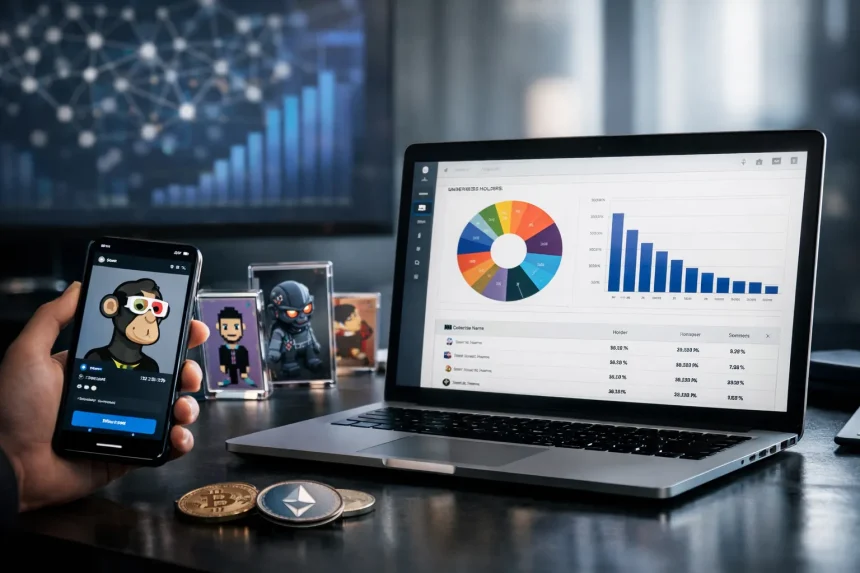
NFT Holder Distribution Explained for Smarter Crypto Decisions
NFT Holder Distribution is one of the most important metrics for evaluating any NFT project, yet it is often misunderstood or ignored. On crypto621, we focus on practical signals that help you reduce risk and spot stronger opportunities. Holder distribution describes how an NFT collection is spread across unique wallet addresses. A collection with broad ownership is generally seen as healthier than one dominated by a small cluster of wallets, because concentrated ownership can amplify volatility, increase manipulation risk, and pressure floor prices during rapid sell offs.
- What NFT Holder Distribution Means
- Why NFT Holder Distribution Matters for Investors
- Key Holder Distribution Signals to Watch
- How to Interpret Whale Concentration
- Holder Distribution and Community Strength
- Common Mistakes When Using NFT Holder Distribution
- Practical Steps to Use Holder Distribution in Your Research
- Final Thoughts on NFT Holder Distribution
When you analyze NFT Holder Distribution, you are essentially asking a simple question. How many different holders exist, and how evenly are tokens spread among them. This matters for traders looking for liquidity, collectors seeking long term community strength, and builders wanting sustainable ecosystems. While no metric should be used alone, holder distribution is a foundational data point that supports better decision making across the entire NFT lifecycle.
What NFT Holder Distribution Means
NFT Holder Distribution measures the number of unique holders and the concentration of tokens among those holders. If a collection has ten thousand items, but only a few hundred wallets hold most of them, ownership is highly concentrated. If thousands of wallets each hold one or two items, ownership is more decentralized.
Distribution is closely linked to legitimacy and organic adoption, but it is not a guarantee. A project can have many holders and still be weak if demand is artificial. Likewise, a smaller holder base can still be strong for premium art where supply is intentionally limited. The key is to interpret distribution relative to the project type, supply size, and trading activity.
Why NFT Holder Distribution Matters for Investors
Healthy distribution often supports healthier markets. When ownership is spread out, floor price movements tend to be less extreme because no single wallet can overwhelm listings. This can lead to more stable price discovery and consistent volume. It can also indicate that a community is real, with many participants rather than a few dominant actors.
Concentrated distribution can create sudden shocks. If a whale wallet or a small group decides to list aggressively, it can depress the floor quickly. Conversely, whales can also create short term pumps by sweeping floors, but those moves may not reflect sustainable demand. For anyone managing risk, NFT Holder Distribution provides context for how fragile or resilient a floor price may be.
Key Holder Distribution Signals to Watch
When evaluating NFT Holder Distribution, focus on a few practical signals that can be compared across projects over time.
- Unique holders count relative to total supply, which indicates how many wallets have exposure
- Top holder concentration, which shows how much control the largest wallets have
- Long tail participation, which reveals whether many small holders exist or only a handful
- Changes over time, which can show whether distribution is improving or centralizing
- Holder behavior patterns, such as frequent transfers that can suggest farming or wash activity
These signals become more powerful when combined with volume trends, listings, social engagement, and on chain activity such as mint patterns or treasury flows.
How to Interpret Whale Concentration
Whales are not automatically a red flag. In some collections, early supporters accumulate because they believe in the team, the art, or future utility. However, extreme whale concentration raises risk, especially when whales control enough items to influence the floor. From a market structure perspective, the more supply controlled by a small group, the more likely the project can experience rapid shifts in price due to coordinated or reactive selling.
On crypto621, we recommend looking at whether whale wallets are long term holders or active flippers. If large holders are consistently listing and relisting, distribution can still be concentrated, but liquidity may be higher. If whales are dormant and then suddenly become active, that change can be an early warning signal of upcoming volatility.
Holder Distribution and Community Strength
NFT communities often thrive when many people feel ownership and participation. A broad holder base can improve community governance, increase event participation, and support healthier secondary markets. It can also strengthen brand value, because more holders act as advocates. When holder distribution is narrow, community perception may shift toward seeing the project as controlled by insiders, which can reduce trust and limit organic growth.
That said, community strength is not purely a function of distribution. It also depends on how holders interact, whether the team delivers value, and if the roadmap is credible. Distribution works best as a supporting metric to validate that community engagement is not driven only by a small segment.
Common Mistakes When Using NFT Holder Distribution
Many traders make the mistake of treating holder distribution as a single score that defines quality. In reality, it requires context. A few common errors can lead to bad decisions.
- Ignoring exchange or marketplace custody wallets that may skew holder counts
- Assuming high holder counts always mean strong demand, even when volume is thin
- Overlooking sybil patterns where one user controls many wallets
- Failing to compare distribution against supply size and project category
- Not tracking distribution changes after reveals, airdrops, or major announcements
A balanced approach is to treat NFT Holder Distribution as one layer in a full due diligence process, not as a final verdict.
Practical Steps to Use Holder Distribution in Your Research
If you want to use NFT Holder Distribution to improve your NFT analysis, adopt a repeatable workflow. First, check unique holders and the concentration of the top wallets. Next, review listing depth and recent sales to understand liquidity. Then evaluate whether holder concentration is trending up or down. Finally, cross check qualitative factors like team transparency, utility delivery, and community health.
For collectors, a widely distributed project can feel safer for long term holding because exit liquidity may be stronger and the community may be broader. For traders, a concentrated collection may offer high volatility opportunities, but it also demands tighter risk controls and faster reaction times.
Final Thoughts on NFT Holder Distribution
NFT Holder Distribution is a core metric for anyone navigating NFTs with a serious mindset. It helps you understand ownership balance, potential manipulation risk, and how resilient a collection might be during market stress. Used alongside volume, listings, and fundamental project evaluation, it becomes a powerful tool for smarter decisions.
crypto621 will continue to cover actionable NFT analytics, including how to read holder data responsibly and how to avoid common traps. If you make NFT Holder Distribution a regular part of your research, you will be better positioned to identify stronger communities and manage risk with more confidence.