
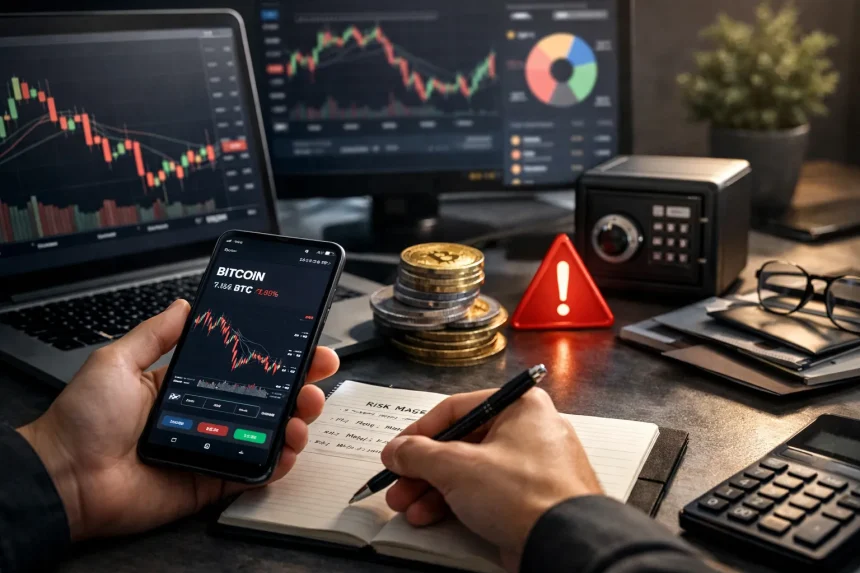
Crypto Risk Management Basics
Crypto markets attract traders and long term investors because they offer innovation, global access, and high potential upside. They also carry unique risks that can surprise newcomers and frustrate experienced participants. On crypto621, understanding Crypto Risk Management Basics means learning how to protect capital first, then pursue returns with a plan. Risk management is not about eliminating uncertainty. It is about making decisions that keep you in the market long enough to learn, adapt, and grow.
- Understand the Core Risks in Crypto
- Set Clear Goals and Time Horizon
- Use Position Sizing to Control Damage
- Plan Entries and Exits With Rules
- Manage Leverage and Avoid Forced Liquidation
- Diversify With Intention, Not Randomness
- Secure Your Assets and Reduce Operational Risk
- Track Performance and Review Your Decisions
- Build a Simple Crypto Risk Management Checklist
Risk management starts with accepting that volatility is normal in digital assets. Prices can move quickly after news, exchange outages, liquidation cascades, or sudden changes in market sentiment. Because of this, people who invest without rules often sell at the worst times or overextend during hype cycles. A simple risk framework can help you avoid emotional decisions and reduce the chance that one position harms your entire portfolio.
Understand the Core Risks in Crypto
Before choosing tools and tactics, identify the main categories of risk. Market risk is the most visible because prices can drop sharply even when a project is healthy. Liquidity risk occurs when you cannot buy or sell at your intended price, often seen in small cap tokens with thin order books. Counterparty risk includes exchange insolvency, withdrawal freezes, and failures of centralized platforms you rely on.
Technical risk matters as well. Smart contract bugs, bridge exploits, and permission errors can lead to permanent losses. Regulatory risk is another factor, since changing rules can limit access to services or affect token viability in certain regions. Finally, operational risk is personal. Losing seed phrases, falling for phishing, or using weak security can be more damaging than a market crash.
Set Clear Goals and Time Horizon
Crypto Risk Management Basics begin with clarity. Decide whether your goal is long term accumulation, medium term investing, or active trading. Each approach needs a different level of monitoring and a different tolerance for drawdowns. A long term investor may accept larger short term declines if the thesis remains intact, while a trader should define invalidation levels quickly and follow them consistently.
Write down your target holding period and what success looks like. For example, you may aim to allocate monthly for multiple years, or to trade only around key events. When goals are specific, position sizing and exit rules become easier to follow.
Use Position Sizing to Control Damage
Position sizing means choosing how much of your portfolio to put into a single asset or trade. This is one of the most powerful risk controls because it limits how much you can lose if you are wrong or if something unexpected happens. Many losses in crypto come from concentration, not from normal volatility.
A practical approach is to cap exposure per asset and cap exposure per theme. A high conviction large cap position may deserve a larger allocation than an experimental micro cap token. If you cannot explain why a position size is justified, it is likely too large. Consider starting smaller and increasing exposure only after you gain more data and confidence.
Plan Entries and Exits With Rules
Another pillar of Crypto Risk Management Basics is deciding in advance when you will enter, take profit, or cut losses. Without rules, people tend to hold losers and sell winners too early. Rules can be technical, such as a price level or trend change, or fundamental, such as a key protocol metric or development milestone.
For traders, defining stop loss logic is essential. For investors, the equivalent is defining what would invalidate your thesis. Thesis invalidation might include security incidents, governance changes, sustained loss of users, or a shift in token economics that harms holders. Profit taking is also risk management because realizing gains reduces pressure and protects capital during downturns.
Manage Leverage and Avoid Forced Liquidation
Leverage can amplify gains but it also increases the chance of catastrophic loss. In crypto, sudden wicks and rapid moves can liquidate positions even when your longer term idea is correct. If you use leverage, keep it modest and assume volatility can expand unexpectedly. Always consider the risk of gaps, funding costs, and exchange stability during high stress events.
Many participants discover too late that leverage risk is not only market risk. It is also platform risk and execution risk. If a platform goes down during a fast move, you may not be able to reduce exposure. For most beginners, avoiding leverage is a rational starting point.
Diversify With Intention, Not Randomness
Diversification can reduce volatility and protect against single asset failures, but only if applied thoughtfully. Holding many tokens that all move together does not provide real diversification. Instead, consider diversifying across categories such as Bitcoin, large cap smart contract platforms, selected infrastructure projects, and smaller experimental allocations.
Also diversify custody. Storing everything on one exchange increases counterparty risk. A blend of reputable platforms and self custody for longer term holdings can reduce the impact of a single point of failure.
Secure Your Assets and Reduce Operational Risk
Security is a foundational part of Crypto Risk Management Basics. Use strong unique passwords and enable multi factor authentication. Beware of fake apps, malicious browser extensions, and social engineering. Verify URLs carefully and avoid clicking unknown links. If you use self custody, store your seed phrase offline and never share it. Consider using a hardware wallet for meaningful amounts.
Test withdrawals and wallet transfers with small amounts before moving large balances. Keep your devices updated and avoid signing transactions you do not understand. In decentralized finance, take time to review contract addresses and permissions, since unlimited approvals can expose you to future risks.
Track Performance and Review Your Decisions
Risk management improves when you measure what you do. Keep a simple log of your entries, exits, reasons, and outcomes. Over time you will see patterns, such as chasing rallies, buying illiquid tokens, or ignoring your own rules. The goal is not perfection. The goal is continuous improvement and fewer large mistakes.
Set a regular review schedule. Monthly reviews work well for investors, while traders may review weekly. Adjust your plan only after thoughtful analysis, not after a single bad day.
Build a Simple Crypto Risk Management Checklist
A checklist turns principles into action. Before entering any position, confirm that the idea fits your goals, the size is appropriate, the custody plan is secure, and your exit rules are defined. This helps lower emotional trading and reduces the chance of preventable loss.
- Define your goal and time horizon for the position
- Limit position size and total exposure to correlated assets
- Choose an entry plan and a clear exit plan
- Decide where the assets will be stored and how you will secure access
- Understand liquidity and whether you can exit during stress
- Avoid unnecessary leverage and plan for volatility
- Review the position regularly and document decisions
Crypto Risk Management Basics are not complicated, but they require consistency. Markets will always be unpredictable, but your process can be stable. By controlling position size, planning exits, focusing on security, and reviewing performance, you can participate in crypto with more confidence and less stress. On crypto621, the best edge is not finding the next token. It is building habits that protect your capital and keep you learning through every market cycle.